
 Cloud & AI Infrastructure
 Devops Live
 Cloud & Cyber Security
 Data & AI Leaders Summit
 Data Centre World
Exhibitors' Products
Data Center Cooling: Why Variable Speed Isn't Enough Without Network Quality
The cooling system must dissipate increasing amounts of heat while maintaining thermal conditions compatible with very high-density computing loads. Air-handling fans, circulation pumps, and compressors account for significant power consumption, and their load profiles vary over time. Variable speed control is an effective solution, provided that its impact on the power supply is also evaluated.
Speed rarely keeps pace with a constant need
In variable-torque systems, such as many centrifugal pumps and fans, the power consumption varies significantly with speed. According to ideal similarity laws, it varies approximately as the cube of the speed; therefore, a moderate reduction in speed can yield significant savings when the process allows it. These laws do not apply identically to all systems; static losses, operating points, and process constraints must be taken into account.
Distinguishing Between Speed Savings and Harmonic Reduction
In particular, the drive prevents continuous operation at full speed when demand is lower. However, its rectifier can absorb non-sinusoidal current and inject harmonic components into the grid. These components contribute to losses and overheating in transformers, cables, and other equipment. They can also interact with the grid’s compensation capacitance and impedance characteristics.
The energy savings associated with speed control should therefore not be directly attributed to ULH technology. The primary purpose of ULH technology is to maintain the quality of the power supplied to the grid and to facilitate the integration of multiple drives.
Understanding THDi
The total harmonic distortion of current, or THDi, compares the root-mean-square (RMS) value of the harmonic components to that of the fundamental component. It should not be confused with the harmonic distortion of voltage at the point of connection, which depends on the power grid and the sum of the loads. Therefore, to ensure an installation is compliant, a power quality analysis must be conducted at its connection point—not merely by referring to a catalog value.
Ultra-low-harmonic solutions
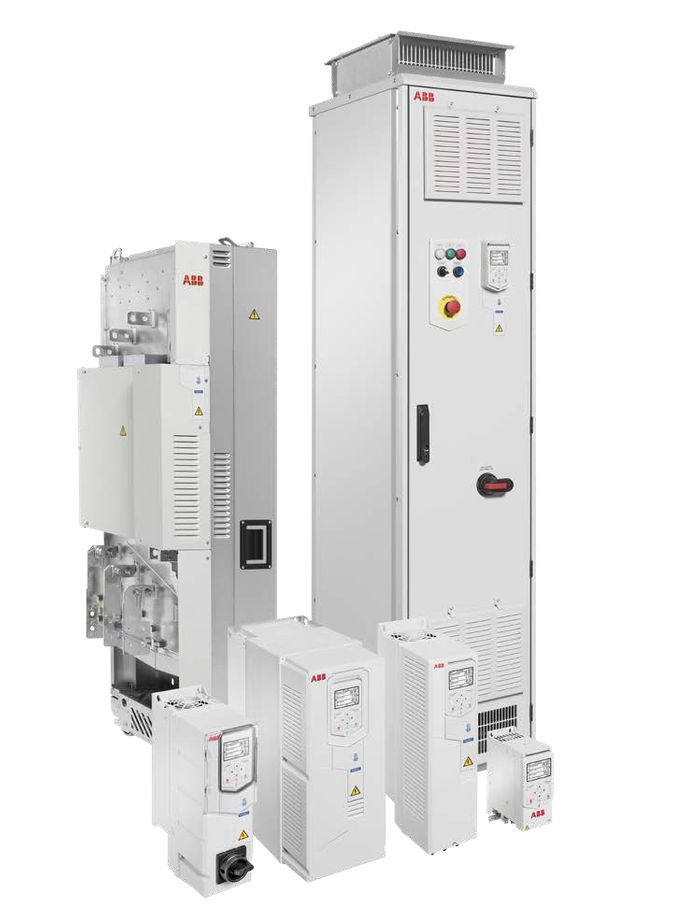
ABB ACH580 ULH drives incorporate harmonic suppression technology. ABB reports a THDi of less than 3% for certain models and operating conditions. In many cases, their architecture eliminates the need for external filters; however, it does not replace the need for studies on the interaction between drives and the power supply. Technical alternatives include inductors, passive or active filters, and appropriate rectifier topologies.
Reliability, Availability, and Liquid Cooling
Cooling is no longer just about air. Liquid cooling circuits, liquid distribution units (CDUs), and large refrigeration systems also require precise pump control. A system analysis combines high-efficiency motors—such as SynRM IE5/IE6 when available—with variable-speed drives, instrumentation, and redundancy strategies. The reliability of a cooling system depends as much on backup and alarm mechanisms as it does on the rated efficiency of each component.
The goal is to provide the necessary thermal capacity using as little auxiliary energy as possible, without causing electrical disturbances that could adversely affect the entire site.
Sources: