
 Cloud & AI Infrastructure
 Devops Live
 Cloud & Cyber Security
 Data & AI Leaders Summit
 Data Centre World
Exhibitors' Products
Granular Electrical Metering: How Can Low-Voltage Service Connections Be Converted into Actionable Data?
A data center’s installed capacity alone does not provide information on the actual power consumption of the various rows and auxiliary equipment. Granular electricity metering addresses an operational need: to know where energy is being consumed, to understand available margins, and to detect discrepancies between expected behavior and actual usage.
Measuring at Multiple Distribution Levels
A metering architecture can cover the delivery point, transformer outputs, main switchboards, RPPs, and terminated feeds to the racks. Each level provides insights into different aspects: energy balance, power quality, load on a feed, or usage profile of a row. The level of granularity should be chosen based on the decisions it actually enables.
The Difference Between Measuring and Concentrating
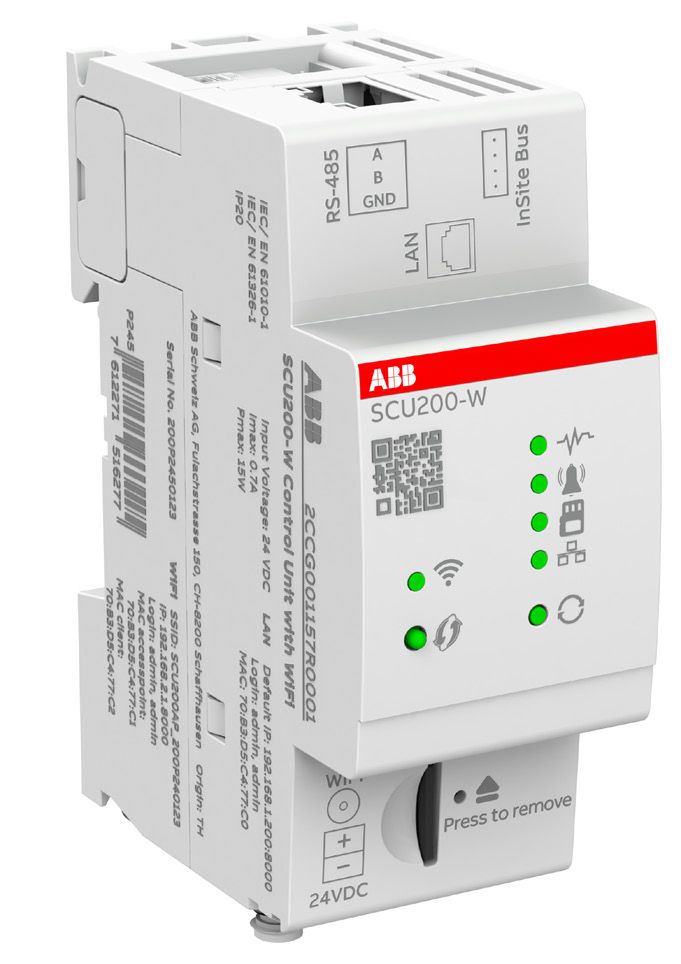
Electrical measurements are performed using meters, current sensors, and instrumentation devices. A control unit such as the SCU200 does not, on its own, serve as a sensor for all the system’s parameters: it collects, organizes, and makes available data generated by associated equipment. ABB InSite can, in particular, centralize information from meters, circuit breakers, and connected sensors.
Detect distribution anomalies
Per-circuit monitoring allows for the tracking of phase imbalances, unusual load changes, or approaching current limits. Operators can use this data to plan an expansion, analyze an incident, and document the availability of electrical capacity. However, an overload alert is not a substitute for electrical protection or the necessary design margins.
From Local Data to BMS and DCIM
Open protocols, particularly Modbus RTU/TCP depending on the equipment, facilitate data transmission to existing monitoring tools. Values and events must be time-stamped and contextualized: a given change in power consumption could result from a new rack, a variation in IA load, or a fault. Access governance, network security, and data integrity are essential to prevent a metering system from becoming a digital weak point.
A modular, scalable architecture
The SCU200 features a built-in web server and can accommodate up to five plug-in expansion modules, depending on the ABB configuration. The modular design allows for the gradual expansion of inputs, communication capabilities, or certain measurement functions. However, the architecture must account for communication capabilities, the actual number of supported sensors, and commissioning constraints.
PUE and Energy Analysis: Be Aware of Measurement Limits
To calculate metrics such as PUE, it is necessary to precisely define the measurement points, time periods, and scope of IT energy consumption. Simply adding up consumption data without a standardized measurement protocol results in double-counting or discrepancies that are difficult to interpret. Effective monitoring is that which is accompanied by a clear methodology and improvement initiatives.
Energy monitoring does not automatically generate savings. It identifies areas where action is needed, verifies the impact of those actions, and documents infrastructure growth based on measured electricity data.
Sources: