 Cloud & AI Infrastructure
 Devops Live
 Cloud & Cyber Security
 Data & AI Leaders Summit
 Data Centre World
News Tech Show Paris
Interview with Cédric O: Can Europe Still Win the Technology Race?
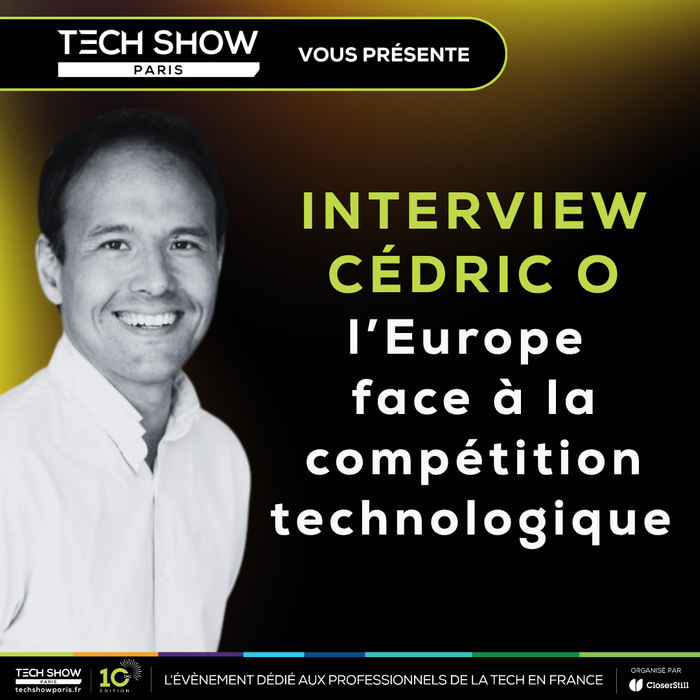
Drawing on a career that spans public policy, industry, and the technology ecosystem, he discusses issues of sovereignty, Europe’s dependence on major technology powers, and the changes needed to enable Europe to regain its influence on the world stage.
"Successfully adopting digital technologies is a matter of vital importance for Europe"
Your background places you at the intersection of technology, public policy, and the entrepreneurial ecosystem. How does this background shape your perspective on Europe’s role in global technological competition?
I’ve had the opportunity to look at this topic from just about every angle: from the government’s perspective, from that of a major industrial group like Safran, from that of an AI company like Mistral AI that’s competing on the global stage right from the start, and now from that of a startup that puts AI at the heart of its products.
In a way, this provides a panoramic view: we see the strengths of the European ecosystem, which are real, and its shortcomings, which are just as real.
But in each of these positions, the same conviction has emerged—and it has only grown stronger: for Europe, successfully adopting digital technologies is not just another issue among many. It is a matter of vital importance.
A New Paradigm for Digital Sovereignty
After your experience working for the government and then at technology companies like Mistral AI, what do you think has changed the most in the European debate on digital sovereignty?
What has changed is America. More specifically, the attitude of the U.S. government.
Until Donald Trump’s second term, it was inconceivable that Washington could pursue interests radically opposed to our own—and, above all, that it would use our dependence—both technological and geostrategic—as leverage against us.
This risk is now apparent. That changes everything.
"We must once again become world-class technology producers."
There is a lot of talk about technological sovereignty, but the term can encompass very different realities. For a European company, what does that mean in practical terms today?
Sovereignty means the independence of one's decisions.
That doesn't mean doing everything yourself: even the United States doesn't do that. Their most advanced chips are manufactured in Taiwan, using Dutch machinery.
This means that your partners depend on you just as much as you depend on them.
Europe is not without resources: it has key components that the Americans lack, from ASML for lithography to Nokia and Ericsson for 5G network equipment.
But the imbalance is far too great. We must once again become world-class technology producers—not to isolate ourselves, but to have a greater influence.
What decision should Europe make now? If Europe were to make a bold decision in the next twelve months to stay in the technological race, what should that decision be?
In the short term, the capital markets union.
While European capital is much less abundant than U.S. capital, this is not due to a lack of savings; it is, among other things, because our capital markets remain fragmented.
The subject is technical; it's not exactly exciting. Yet it is crucial.
In the medium term, we will need to go much further in terms of fiscal and social integration. The primary source of American companies’ strength is the size of their market.
Europe, for its part, remains largely a collection of 27 separate markets. It would take courage to finally agree to merge them into a single market.
"No one can succeed on their own"
Tech Show Paris brings together decision-makers, technical experts, innovative companies, and public sector representatives to discuss major technological choices. Why are these forums for dialogue important at a time when digital decisions involve so many dependencies, risks, and opportunities?
DIn a world shaped by AI and fraught with uncertainty, I believe in connection.
I believe in cross-fertilization—between engineers and policymakers, and between large corporations and startups.
What is happening right now—particularly with AI—is of fundamental importance, and it presents an immense challenge: the transformation of our economies and societies will be profound.
No one can succeed alone. Let's rise to the challenge—together.
Come see Cédric O at Tech Show Paris 2026 on November 18 & 19 at Paris Expo Porte de Versailles.
Sign up so you don't miss a thing