
 Cloud & AI Infrastructure
 Devops Live
 Cloud & Cyber Security
 Data & AI Leaders Summit
 Data Centre World
Industry News
The Room as an Interface: How L-Acoustics Transforms Sound into Spatial Data
Jaya Sexton, conference manager at Tech Show Paris, visited L-Acoustics’ Highgate Experience Center in London to explore the company’s audio systems. This video offers a glimpse of the demonstration, as well as a conversation with Nick Fichte, Director of Global Business Development for the Hospitality, Home & Yacht sectors, and Mary-Beth Henson, Director of Media Relations.
The accompanying article explores how data, AI, and acoustic engineering are transforming the way spaces respond to people, content, and their context.
For Tech Show Paris, this discussion connects a French deep-tech company to a broader question facing technology leaders: What happens when physical environments become smart?
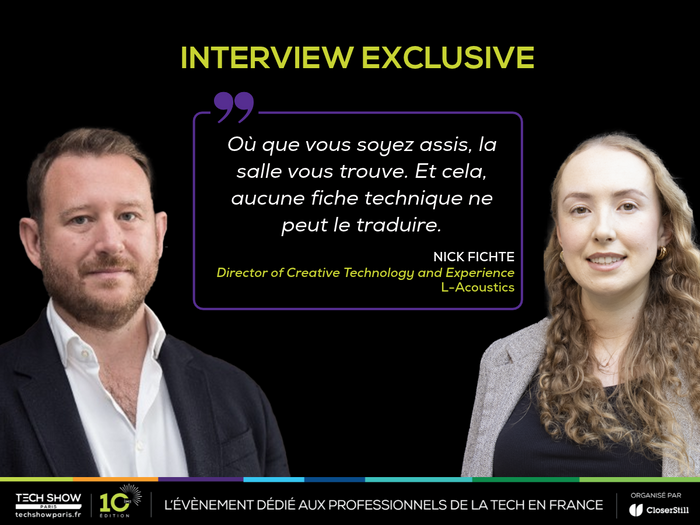
“No matter where you’re seated, the room finds you. And that’s something no spec sheet can capture.”
Nick Fichte, Director of Global Business Development — Hospitality, Home & Yacht, L-Acoustics
When you walk into the Highgate Experience Center for the first time, what do you want visitors to understand that a product spec sheet could never convey?
Nick Fichte
This venue is capable of things that a technical spec sheet could never describe.
We can explain that sixty speakers are hidden behind the fabric walls, that microphones pick up sound in the space and adjust it in real time, or that machine learning discreetly determines where each element of the mix should be positioned around you.
But none of that prepares you for the moment when the room transforms right before your eyes—from an intimate jazz club to the front row of a stadium, or from a Dolby Atmos film mix to a stereo record that suddenly reveals a depth it never had before.
What we want a visitor experiencing the space for the first time to feel is that the space adapts to them, not the other way around. There is no ideal listening spot to seek out, nor any compromise to be made between where the sofa looks best and where the audio sounds best.
No matter where you sit, the room finds you. And that’s something no spec sheet can convey.
The space was originally designed as an R&D environment before becoming a showroom. What changed when the room transitioned from a technical testing facility to an experiential space?
Nick Fichte
When the space was transformed into a showroom, it showcased two L-Acoustics solutions: “Island” and “Ocean.” These audio solutions were light-years ahead of anything visitors had experienced in traditional audio showrooms up to that point, and it was essential that the venue offer a high-end experience.
Carefully selected works of art from our founder’s collection, along with furniture he had personally chosen, helped create a space that was both luxurious and warm.
In its most recent version, a new approach has been adopted. Previously, technology took center stage: the speakers were on display and highlighted to showcase them. As soon as someone entered the space, it was clear that they were in for an exceptional audio experience.
Now, the first things visitors notice are the interior design and the natural acoustics of the space. When they walk in, the first thing they often say is “Wow,” even before we’ve played a single note.
This approach stems from the fact that the connection between sound and design has never been more evident than it is today. We want architects, designers, and end users to consider sound from the very earliest stages of designing their spaces—not only in terms of choosing and integrating speakers, but also by asking themselves how a space sounds when it is quiet.
This new approach becomes clear right from the start of the demonstration.
Beyond the listening room, where is AI already transforming the way L-Acoustics designs and manufactures its systems?
Aurélie Le Cain
Beyond the listening room, AI is already transforming the way L-Acoustics designs, manufactures, and ensures the quality of its products.
Our goal is to transition from reactive quality control to predictive quality control by combining data from acoustic tests, visual inspections, IoT sensors, and production data.
Specifically, we have deployed an IoT platform that monitors our production lines in real time. It consolidates data from machines and industrial equipment, detects deviations, generates automatic alerts, and provides teams with immediate visibility into process performance and compliance.
At the same time, our Data Science and Computer Vision teams are developing automated quality control solutions capable of visually analyzing components and identifying defects with a high degree of accuracy.
These systems inspect products using images, detect anomalies, and automate critical inspection points that were previously performed manually.
The true value becomes apparent when we cross-reference these different data sources.
Today, we analyze tens of thousands of acoustic test results—supplemented by environmental conditions and manufacturing data—to identify subtle signs that may indicate a decline in quality.
The goal is no longer simply to detect a defect after it occurs, but to anticipate deviations, understand their root causes, and adjust processes before they affect the final product.
At L-Acoustics, data-driven quality means that every loudspeaker undergoes expert listening evaluations, AI-assisted visual inspections, real-time IoT monitoring, and algorithms capable of predicting acoustic deviations.
It is this convergence of acoustics, vision, the Internet of Things, and artificial intelligence that enables us to scale excellence while maintaining the high standards for which our systems are renowned.
The Highgate Experience Center can switch from one acoustic environment to another thanks to HYRISS. What does this capability tell us about the future of cultural venues, workspaces, and residential spaces?
Nick Fichte
The most important lesson is that we no longer need a separate room for each experiment.
For a long time, a movie theater was just a movie theater, a listening room was just a listening room, and a meeting space was just a meeting space—because the acoustics and the speakers were fixed.
HYRISS challenges this way of thinking. A cultural venue can host a chamber music concert at 7 p.m. and then a film screening at 10 p.m. without moving a single speaker.
A workspace can be transformed into a broadcast studio in the morning, then into an auditorium for a plenary meeting in the afternoon. A home can become a private movie theater in the evening, then, the next day, a quiet space where the owner listens to their favorite album.
What's happening behind the scenes is that the L-ISA Processor Core allows users to reconfigure the space in a way that previously required the physical intervention of architects and integrators.
This has real implications in terms of costs, real estate, and design: a well-designed room can gradually replace three specialized rooms.
This development is made possible by two technologies. Anima uses machine learning to distinguish between instruments and different sounds, then spatializes the content in real time, on the fly. Ambiance, meanwhile, adjusts the room’s acoustics in real time with the simple push of a button.
The future we envision is one in which acoustics finally catches up with the possibilities that lighting has offered for the past twenty years: creating a variable that the homeowner can control, rather than a fixed constraint around which they must design the space.
How should business leaders view sound as a component of the digital experience?
Nick Fichte
All of these industries have spent years carefully considering the appearance of a space, its lighting, and how materials are perceived… only to treat sound as something the audiovisual integrator has managed to hide in the ceiling.
This discrepancy is surprising, since sound is one of the quickest ways to change how a customer, guest, or employee actually feels in a space.
What machine learning changes in this line of thinking is the level of control it makes possible.
You no longer simply choose between “playlist on” and “playlist off.” You can decide that the entrance to a flagship store offers an intimate atmosphere when it opens, then a more spacious one during peak hours; that a hotel bar is a listening room at 6 p.m. and a dance floor at midnight; or that a workspace features areas for concentration and collaboration that reconfigure throughout the day.
All without having to redesign the space or call in an acoustics specialist every time there’s a change.
“My sincere advice to executives is to stop thinking of sound as a budget line item managed by the procurement department, and instead start treating it the same way they treat their visual identity: as an experience that they design, measure, and evolve.”
The technology needed to do this on a large scale now exists.
Evidence shows that when acoustics are taken into account from the very beginning of a project—starting with the initial stages following the architects’ appointment—the final result is always optimal.
Just as an architect might ask a client, “What is the purpose of this room, and how will you use it?”, we ask the same question. We can then work together to ensure that the technology and the architecture work in harmony.
Once the interior designer has been selected, they know what elements to incorporate and what constraints to consider when integrating the system. This allows us to work closely together from the very beginning.
When we get involved late in a project—once the architecture and interior design have been finalized and presented to the client, or worse yet, approved—the project turns into a power struggle.
There are always trade-offs, which will affect either the aesthetics and atmosphere of the space or the performance of the audio system and what it is capable of achieving.
How do you see the connection between the discussions about data at Tech Show Paris and the hands-on experience demonstrated at Highgate?
Aurélie Le Cain
The connection is very direct.
At Tech Show Paris, we talk about data, AI, and digital transformation. At Highgate, we show why we do it: to ensure impeccable quality right down to the physical product the customer receives.
At L-Acoustics, data is not an end in itself. It is a means of pursuing our long-standing commitment to perfection.
Our audio systems are designed to extremely tight tolerances, and each speaker must deliver exactly the expected performance.
To achieve this level of excellence on a large scale, we now rely on data, the IoT, data science, and AI.
Whether it’s improving industrial quality, optimizing production, making decision-making more reliable, or helping our teams perform better, our goal remains the same: to use data and artificial intelligence to drive operational excellence and enhance the customer experience.
Ultimately, the discussions about data at the event in Paris and the hands-on experience here in Highgate tell the same story: that of a company using technology to make excellence reproducible.
Behind every acoustic demonstration are, above all, passionate experts, years of research, countless tests, and close collaboration between R&D, industry, and the Data & AI teams.
Data and artificial intelligence are catalysts, but they do not replace the human expertise or the physical innovation that are at the heart of L-Acoustics.
They help us measure, understand, and reproduce with even greater precision what our engineers have always strived for: acoustic perfection, reliability, and an exceptional listening experience.
Visit L-Acoustics at Tech Show Paris
To learn more about the transition from impressive agent-based systems in demonstrations to reliable production solutions, join Mokhtar Bouain, AI Agentic Solutions Architect at L-Acoustics, for the Cloud T2 Keynote on Thursday, November 19, from 12:35 p.m. to 1:00 p.m.
"From Demo to Production: The Step AI Agents Can't Take Alone"
REGISTER TO VISIT THE TRADE SHOW
We look forward to seeing you on November 18 and 19, 2026, at Paris Expo Porte de Versailles for the 10th edition of Tech Show Paris.